

Above: UCSC faculty and staff in front of the Lanyon Building at Queens University Belfast.
“All the world’s a stage,” Shakespeare wrote, and UCSC drama professor Patty Gallagher has some definite thoughts about that—for students and faculty alike.
This past April, Gallagher and 11 other UCSC faculty traveled to England and Northern Ireland for the first Faculty Seminar Away program, visiting universities abroad to make connections, explore research opportunities, and build long-lasting institutional partnerships to benefit the UCSC community for years to come.
“In theater, we often say ‘feet on the stage,’” said Gallagher. “‘Feet on the stage.’ That’s where things become real, where things become scariest, most possible, most delightful. That’s where uncertainty lies. So I say, get your feet onto the soil of another country. Plunge into the uncertainty. Put your feet on the soil of another part of the world, because it will change you forever.”
As a junior in college in the U.S., Gallagher enrolled in a London- and Stratford-based theater program, where she ended up studying Shakespeare with award-winning actor Patrick Stewart as a teacher. She credits that international learning experience with completely changing her as an artist and thinker, and opening the door to a greater world. Today, as a professor in the Department of Performance, Play and Design, she is teaching two classes this quarter—an upper-division acting studio focusing on movement, physical comedy, and clown traditions throughout the world, and a preproduction class preparing for her upcoming direction of Shakespeare’s The Comedy of Errors. Gallagher would love for her students and fellow faculty to experience something similar in their own fields of interest.
Exciting collaborations
Usually, people think of a university’s abroad programs as learning opportunities for students. UCSC offers a wide variety of these, including its expanding Global Classrooms program for students who prefer virtual study abroad. But UCSC’s Global Engagement Division has also created something new: a unique faculty-driven, partnership-building program that sends interdisciplinary groups to universities abroad for one week. The first cohort of 12 faculty members represented UCSC’s five academic divisions—Arts, Humanities, Physical and Biological Sciences, Social Sciences, and the Baskin School of Engineering—and was delighted to discover that they got just as much out of engaging with their fellow UCSC professors as they did with their counterparts at Queen’s University Belfast, Northern Ireland, and at the University of Bristol in England.
Now, exciting collaborations are materializing on all fronts.
Tim Johnstone, associate professor of chemistry and biochemistry and associate provost of Crown College, had previously traveled to the U.K. at age 16 with his parents (both bagpipers), but had never participated in any kind of organized study abroad program. Now he’s excited to share his enthusiasm for learning abroad with students and faculty.
“This was all new to me,” he said, recalling the beauty of Ireland’s lush green fields dotted with white sheep, which the faculty team saw as they traveled to Queen’s University. “When I describe this experience to people, I say there was a biologist and an economist and a historian, and that’s usually when people’s faces start to look confused. It’s a lot of fun to highlight what a fascinating, cross-cutting excursion we went on.”
Global engagement is critical if you want to stay on the cutting edge of science, Johnstone said. And it’s often the interpersonal relationships that pave the way for establishing invaluable scientific collaborations. Johnstone finds it most effective to sit down and talk directly with people—in situations where conversations naturally unfold—particularly when pitching an idea. He thinks creating more opportunities like this should be a priority.
“UCSC has a really unique footprint in science and the capacity for significant global impact,” he said. “We should be playing a bigger role on the global stage in research and other areas, and I want to help with that.”
Complementary expertise
Sri Kurniawan, professor of computational media in the Baskin School of Engineering, shares Johnstone’s excitement about the collaborative potential that the Faculty Seminar Away is opening up between institutions. Kurniawan was selected last year as one of the Titans of Tech in Santa Cruz. Her research includes working on games and computer applications to increase educational opportunities for children with Autism Spectrum Disorder (ASD). While participating in the Faculty Seminar Away, she discovered that Queen’s University offers a master’s degree in ASD and was introduced to a group called Media Lab that works on a variety of interactive media experiences, including virtual reality programs for children with ASD. She has already started working with faculty and connections there and at the University of Bristol in ways that complement each other’s expertise.
“There’s this idea that children with autism can’t learn by themselves, that they always need help,” Kurniawan said. “A collaborator that I met in Belfast is actually an expert who argued that if you provide the appropriate scaffolding, children with autism can learn by themselves; the problem is not with the children, but with the educational scaffolding design. This expert created a series of guidelines for how to design such scaffolding, and when I met him last spring I said that if we built it in virtual reality, we could create a virtual world that would support self-learning for children with autism. This expert is the partner of the course director of the master’s degree in ASD I was meeting with at Queen’s who I’d already clicked with; she introduced us, and now we have a wonderful collaboration. I wouldn’t have met either of them without this program.”
Internationalizing UC Santa Cruz
Becky George, assistant vice provost of global engagement and senior international officer, came up with the idea for the Faculty Seminar Away as part of UCSC’s Strategic Plan for Internationalization. Innovating on a program that the University of Richmond was already running, George focused on partnership-building, hoping that faculty could connect and nurture professional relationships, leading to a long-lasting international network of institutional partnerships.
“Faculty aren’t usually introduced to partnership-building with universities abroad,” George said. “We see this as a group endeavor now, and we look forward to the outcomes: return visits from our partners, keeping the dialogue going from the initial exploratory visits, and planning future seminars. We hope to focus our next seminar on Latin America.”
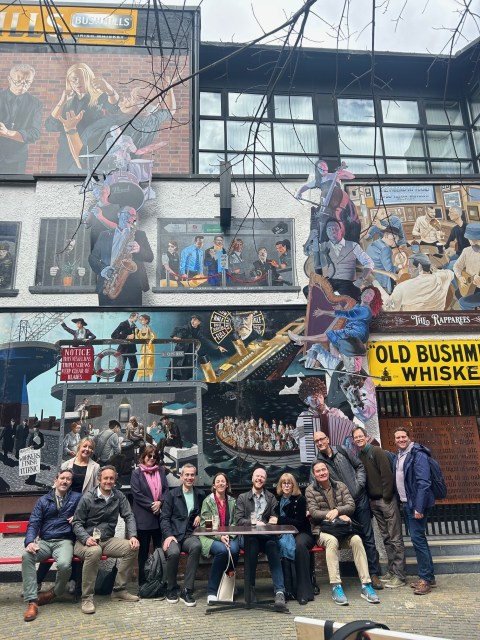
UCSC faculty and staff exploring the Cathedral Quarter in Belfast.
Division of Global Engagement personnel hope that UCSC faculty will click with colleagues abroad. The division believes that these new faculty relationships will benefit students and help make vital connections that lead to research collaboration and funding opportunities; increased student mobility (since internationally engaged faculty will likely encourage their students to study abroad); an expanded international network for graduate and undergraduate students; summer research stays for undergraduate students; and more.
“We’re trying to build these connections out at an institutional level, so they can become mutually beneficial partnerships that go on even after a faculty member leaves,” said George.
The Division of Global Engagement also hopes to introduce faculty to how much a meaningful institutional partnership can entail, with a broad swath of activities including everything from Global Classrooms, to exchange, to research, to multinational corporate internship opportunities. Developing such relationships with universities abroad can enable all kinds of international activities and benefits for students and faculty. One long-term goal is to amplify UCSC’s reputation and recognition abroad, which can lead to increased international student recruitment, graduate and exchange students wanting to come to UCSC, and opportunities for external sources of funding for faculty research.
UC Santa Cruz earns national acclaim
In recognition of excellence in internationalization efforts, UC Santa Cruz was selected earlier this year to receive the prestigious 2024 Senator Paul Simon Award for Comprehensive Internationalization. Read more about this national and international recognition.
“I know this sounds kind of corny, but our ultimate goal in all of this is really world peace,” said George. “Making friends, becoming part of a society that cares about other cultures and people from other parts of the world.”
New plans, ideas, and connections
Faculty remarked that many of their bonds, conversations, and moments of joy on the trip were found in interstitial moments as they traveled together from place to place, and activity to activity.
“Walking the quiet, beautiful cobbled streets of Bristol on our way home from the Old Vic theater and just being together, wandering through the night with our heads full of ideas, full of gratitude for being together,” said Gallagher. “It was a magical trip. And now we’re finding ways to work together at UCSC.”
At week’s end, Johnstone recalls the melancholy feeling that faculty seemed to share as they rode together in a van to Heathrow Airport, about to head back to the United States.
“When you have a smaller group that you’re spending a lot of time with, you quickly establish some strong friendships with them,” he said. “On the personal side, there’s definitely a sadness at the end of it. But on the professional side, I was excited to be leaving because I was walking away with new plans, ideas, and connections that I knew I’d be reaching out to continue. I’m really excited to see what the future holds. And I would encourage any faculty member thinking about doing this, to do it.”
The immersive aspect of UCSC’s Faculty Seminar Away provides exciting opportunities for participating faculty to connect with academic counterparts and the greater world in ways that would not be possible from home. Last spring’s experience of traveling, personally connecting with faculty abroad, and for one week exploring the wider world with UCSC colleagues reminds Gallagher of the difference between reading a Shakespeare play and experiencing it live in the theater.
“I would say about Shakespeare, don’t just look at it on the page,” Gallagher said. “Stand up, walk around, say it out loud. It’s like an instrument that must have human breath blown through. Shakespeare’s not just the words on the page—it’s like the difference between looking at sheet music and actually hearing or playing music and being immersed in the full beauty of it,” said Gallagher. “The same goes for learning and connecting abroad. And I’m very grateful to have been able to share this opportunity with my colleagues (now my friends).
“As Shakespeare’s Coriolanus says, ‘There is a world elsewhere,’” Gallagher added. “Global Engagement helps faculty and students explore the world(s) they seek.”