

Above: Pedro Morales-Almazán, associate teaching professor, undergraduate vice chair, Mathematics Department (photo by Carolyn Lagattuta)
Pedro Morales-Almazán has heard it a million times. Maybe you’ve even said it yourself.
Ugh, I hate math.
But Morales-Almazán has news for you. Whatever you love—whether it’s cooking, art, technology, sports, psychology, music, poetry—if you go deep down into it, you will find some math there. And that’s just where this award-winning UCSC associate teaching professor of mathematics likes to start when sharing the wonder and excitement of mathematics theory: by highlighting math’s relevance to his students’ interests, experiences, and worldviews.
He also throws in a bad joke or two.
“A lot of people get discouraged early with math,” said Morales-Almazán. “And it’s sad, because deeper mathematics theory is actually quite different from what we learn in K–12 education. Math is not about computing. It’s about arguing ideas. We don’t care about finding a number—numbers by themselves don’t mean anything. How you arrive into that number is really what matters.”
Whatever Morales-Almazán is doing, it’s working.
This past spring, he won an Excellence in Teaching Award from the Academic Senate’s Committee on Teaching, one of only eight honorees out of 370 nominations.
“Lectures were extremely engaging and real-life focused; professor Pedro was clearly very passionate about what he was teaching, and it showed in his explanations,” wrote one student in their nomination.
“I particularly appreciate that he stressed why what we were learning was important, what it could be applied to in the future for our careers,” wrote another student. “He is an excellent teacher and made me feel confident and inspired about math again.”
An endless world

Morales-Almazán teaches students that math “is not about computing. It’s about arguing ideas. We don’t care about finding a number—numbers by themselves don’t mean anything. How you arrive into that number is really what matters.”
Morales-Almazán can relate to students’ initial disinterest in math, because as an only child growing up in Guatemala City, the capital of Guatemala, mathematics was just another subject for him in school. His father passed away when he was 9, and he spent his afternoons (after homework was done) watching TV, playing guitar, drawing in notebooks, and seeing friends. His mother—a teacher and lawyer—stressed the value of education and a strong work ethic and encouraged him to pursue whatever he wanted, which included the high school math club he joined at age 14.
He enjoyed the competition side of math club and math Olympiads, and was ultimately selected as one of six students to represent Guatemala in the International Mathematical Olympiad. The national program’s training camp ran for six months—all day every Saturday—and the college professors serving as trainers invited their small group of high school students to sit in on college courses.
“That’s where I discovered, ‘Wait, math is actually different from what I’ve seen in school—it’s not about calculus, it’s not about computing things,’” said Morales-Almazán. “I saw number theory and linear algebra and real analysis, and it was very interesting. It sparked my curiosity. It’s like an endless world where you can keep discovering things.”
The value of different paths
Inspired by his new understanding of math’s infinite possibilities, and by his ensuing successes in national and international math Olympiads, Morales-Almazán went on to earn a B.S. in applied mathematics and a B.E. in electronics engineering at Universidad de San Carlos de Guatemala. He then moved to the United States, earning his M.Sc. and Ph.D. at Baylor University in Texas, specializing in mathematical physics, specifically zeta functions.
After five years of working as a lecturer at the University of Texas at Austin, he moved to Santa Cruz and began teaching at UCSC, where he loves sharing mathematics with students and serving as associate dean of diversity, equity, and inclusion for the Physical and Biological Sciences Division. In addition to winning the Excellence in Teaching Award, he is the Ron Ruby Teaching Award recipient, and collaboratively leads the UCSC/CSU Monterey Bay “Building Data Science Communities for Improving Student Success” project.
Morales-Almazán said that his experience of moving from Guatemala to the United States as a young man helps him think deeply about the value of different paths that people take in school, work, and life.
“It’s funny, because pretty much everyone you talk to says ‘I didn’t have a traditional path’ to whatever they’re doing,” Morales-Almazán said. “And the more you talk to people, the more it seems that actually no one had a traditional path. Which means that the concept of a ‘traditional path’ is not really that factual, and it probably just works against us. Because it makes us feel like we should have done something else, or we should be somewhere else, or that we couldn’t accomplish something new because we’re not on a certain path.”
One diversity issue that continues to plague the field of mathematics is the myth that girls and math don’t mix. Nothing could be further from the truth, says Morales-Almazán, who is quick to point out that, generally speaking, girls actually tend to perform a little better than boys in K–12 math, but that this drops off considerably once women reach higher education.
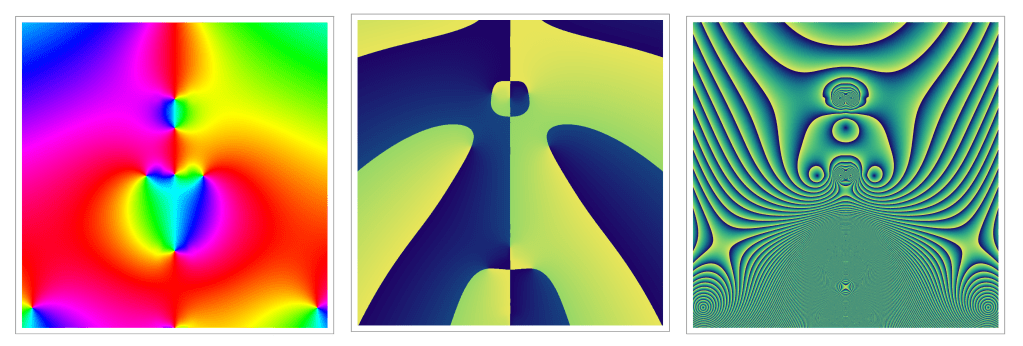
These images were generated using the spectral zeta function for a two-dimensional spherical shell with Gaussian and mixed Gaussian potentials in Mathematica.
“You can lift someone up with the type of feedback you give or you can push them down, and sadly, I think that’s been the case for a lot of girls in our system,” he said. “As a society, and as teachers, we need to do better in supporting and encouraging all our students to pursue what they want.”
Balance in life
Morales-Almazán’s teaching and associate dean role keep him busy, but in his free time he loves reading and learning about topics outside of math. He reads and writes poetry; loves music, bouldering (a form of rock climbing), and mountain biking; studies improv; is collaborating with colleagues on a book about applications of improv to higher education; and is writing a book of his own about the hidden math used in describing various fields such as art, economy, and science. His general philosophy, which he tries to impart to students, is to be balanced in life—to take breaks, take care of yourself, and vary what you do.
Reflecting on a question he’s heard countless times over the years—I’m never going to use algebra, geometry, etc., in life, so why should I learn it?—Morales-Almazán offered an explanation that he likes to share with his students.
“You go to the gym and lift weights, not because you’re going to spend time outside the gym lifting heavy boxes,” he said. “You do a Zumba class, not because you want to be better at Zumba in your free time. You do these things for your own health, to increase your mobility, maybe even your physical appearance. It’s the same thing with learning math. You do algebra, say, not because you’re going to solve equations in your free time or future life, but because you’re training your mind to have a thinking structure that you can apply to a wide range of situations and challenges throughout your life. Math is training for your brain, so you can apply the critical thinking we use in class and apply the organized logical structure you learn from math to whatever you want to do in life. That’s the real value. That’s why the most important thing is thinking about how you arrived at the answer—thinking about the path you took to get there—instead of focusing on getting ‘the one right answer’ that everyone else seems to have, and feeling like you failed if you didn’t.
“Everyone has their own path in life,” he added. “I believe there’s a path for everyone in mathematics, too.”