

Above: David Huntley and Eric Reynolds rest on their climb of El Capitan in 1972. (Photo courtesy David Huntley)
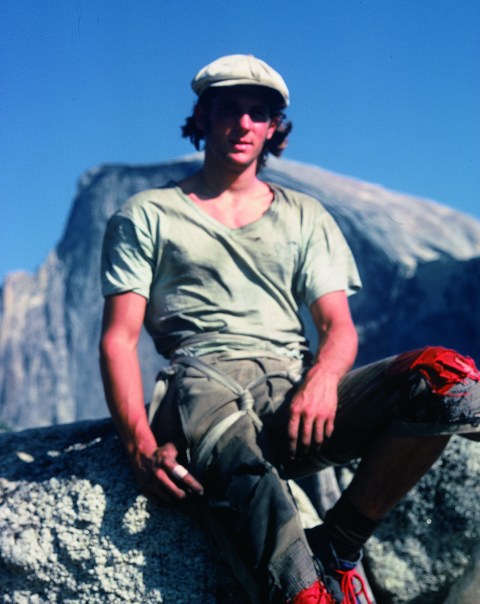
Eric Reynolds after a climb in Yosemite in 1971. (Photo courtesy David Huntley)
While at UC Santa Cruz in the early ’70s, David Huntley and Eric Reynolds spent almost as much time scaling rock faces as they did in classrooms. They frequented Yosemite, climbed El Capitan twice, and participated in the Juneau Icefield Research Program. When Huntley needed somewhere to take his climbing students in Santa Cruz, he led them up the outer walls of McHenry Library (at night to avoid trouble, of course).
What began as a side hobby at UCSC quickly turned into Huntley’s (Stevenson ’74, Earth sciences and biology) and Reynolds’s (Crown) deep passion. Huntley started crafting custom sleeping bags he’d sew and sell to fellow students from his dorm room. He enlisted the help of Santa Cruz local Dave Meeks, who owned Custom Alpine Equipment, where he learned some of the ins and outs of quality sewing and down-filled product assembly.
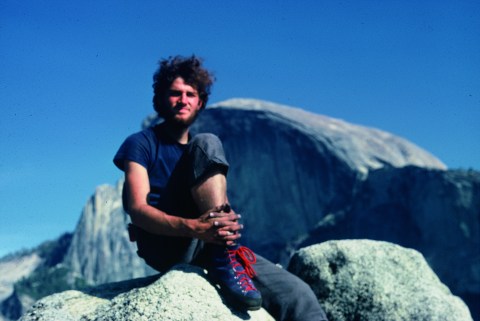
David Huntley after a climb in Yosemite in 1971. (Photo courtesy David Huntley)
In late 1973 Huntley, Reynolds, and future business partner Tom Boyce attempted the first winter ascent of a multi-day climb in Yosemite, but withdrew after Huntley fell and injured a knee in the early part of the climb. They retreated to a friend’s home in Davis for about a week. It was during that week that they decided to start a business together. After leaving UCSC, Huntley and Reynolds, along with Boyce, took their love of climbing and launched Marmot in 1974, creating one of the most iconic names in outdoor gear.
“One thing that was a little different about Marmot was that we were climbers who couldn’t afford stuff when we were in school,” Huntley said. “A lot of the products that we used as climbers just didn’t hold up to abuse, and so one of the key ideas behind Marmot was to make gear for people who needed it to last.”
Marmot’s beginnings
Huntley, Reynolds, and Boyce opened Marmot Mountain Works in Grand Junction, Colo., in 1974. Huntley and Reynolds were the primary designers and production crew. They rented a 100-year-old, 1,000-square-foot stone building with the front section of the building as their storefront, while the back served as their workshop.
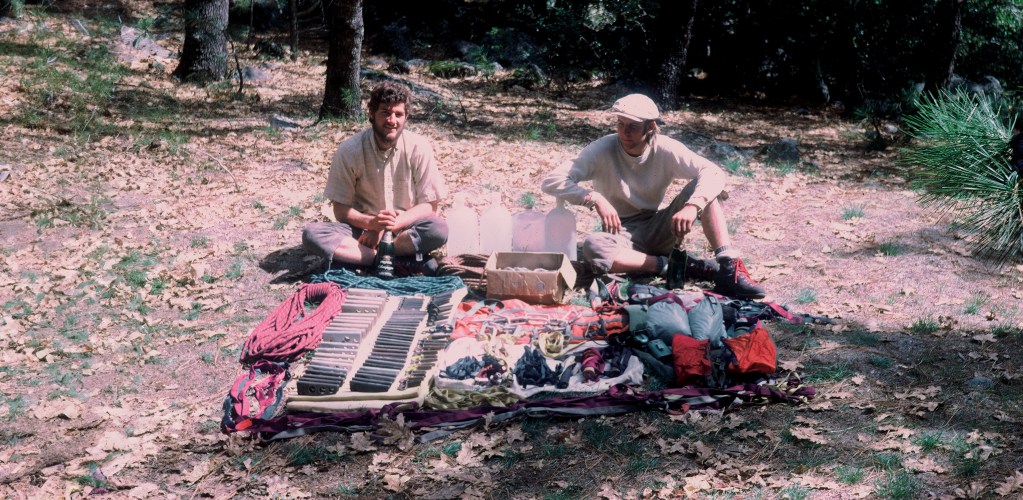
David Huntley and Eric Reynolds prepare to climb El Capitan in 1972. (Photo courtesy David Huntley)
The same year, they got their first deal to make about 50 down sweaters and expedition parkas for a Clint Eastwood movie, The Eiger Sanction, after a cameraman came across a sleeping bag Huntley had sold to Boyce.
“We said, ‘There’s no way we can get them to you in time,’ and they said, ‘Well, this is Universal Studios—we’ll prepay. Overcharge us, and get us those parkas,’” Huntley recalled. “So that was sort of the kick in the pants that really got the momentum going.”
“We hadn’t even designed them yet,” Reynolds said. “But Dave, within, I don’t know, a week or two, had the patterns ready and made samples, and we sent them off and we got the contract.”
After pulling multiple all-nighters sewing the jackets, and enlisting the help of a seamstress from the awning shop next door, they got the order to Universal Studios by the deadline. Soon they were hiring more sewers and sending Marmot merchandise to climbing stores across the country to pitch their product. Year after year, they got into a cycle of building up inventory for the winter, selling out, and doing it all over again.
Going big with Gore-Tex
Two years in, Huntley and Reynolds began receiving sales calls from W. L. Gore & Associates, who were just beginning to develop Gore-Tex fabric. A groundbreaking technology at the time, Gore-Tex claimed to be both breathable and waterproof. To test the claims, Huntley and Reynolds ordered samples, made some sleeping bags, and slept multiple nights in a local commercial freezer surrounded by pizzas and desserts. To their surprise, the product worked, and in 1976, they introduced Gore-Tex to their gear and opened a second store in Berkeley, Calif. Marmot became one of the first companies to sell outdoor gear designed with Gore-Tex technology.

David Huntley’s notes on sleeping bag construction, 1975. (Photo courtesy David Huntley)
“That’s when we really started to explode,” Reynolds said. “We built a store in Berkeley, the most competitive outdoor market in the country. And that store was almost immediately profitable. We made a big splash.”
By the end of year four, Marmot had 50–60 employees and was doing a couple of million dollars in sales.
“We were growing like mad,” Huntley said. “I got a little nervous that we were borrowing more than we were making.”
To help the company raise capital, Huntley sold his shares back to Marmot in 1979 at book value and continued to work as the head designer. A couple years later, Boyce sold his shares while Reynolds remained CEO of Marmot until 1987. With production located in Grand Junction, it became difficult for Marmot to compete with companies using offshore facilities, and after a long run with their business, they were ready to move on to something new.

David Huntley, Eric Reynolds, and Tom Boyce opened Marmot Mountain Works in Grand Junction, Colo. They rented a 100-year-old, 1,000-square-foot stone building. (Photo courtesy David Huntley)
Although Huntley, Reynolds, and Boyce are no longer associated with Marmot, the company continued to grow and is currently celebrating its 50th anniversary.
“Part of the reason Marmot survived and continued is because of these values that we put in place that were, you know, really high-quality products first before everything,” Huntley said.
After Marmot, Huntley and Reynolds founded their own companies. Huntley earned his master’s degree in management from Yale University and then returned to his hometown of Seattle in 1989 with his wife. He is the founder of SmallNetworks, bringing state-of-the-art communications and network infrastructure services to small-office customers in the Seattle area for over 25 years.
Reynolds relocated to Boulder, Colo., and started his company, Sweetwater in 1993, making water filters for backpackers and trekkers. After a couple of years, Reynolds sold the company but remained as a consultant. He founded the eco-friendly outdoor-clothing company Nau in Portland, Ore., in 2003, and then in 2008, he founded Inyenyeri in Rwanda, a social benefit company that strove to solve problems caused by traditional cooking methods. Inyenyeri’s work gained the attention of various outlets including the New York Times, Nonprofit Chronicles, and the World Bank. Reynolds married, moved back to Boulder, and has two children.
A friendship built to last
Huntley and Reynolds have no regrets about parting with their shares of Marmot. For them, the most meaningful part of the journey was the enduring friendship they forged along the way and the shared love for climbing that sparked it all. They remain proud to own the story of Marmot’s founding and are grateful for their friendship.
Both credit the other for laying the foundation for Marmot’s early success.
“I deeply respected and still today brag about how Dave was the genius behind it all,” Reynolds said. “He did all the bookkeeping, designing, pattern making—he did everything. He had intelligence, creativity, and genius.”
Huntley has similar words of admiration for Reynolds.
“Really, he was the guy who came up with so many of the ideas,” Huntley said. “I have always thought of Eric as not just an equal partner, but in many ways, so much more qualified to do a lot of the stuff that we had to do as a business.”