

From tracking the foraging habits of elephant seals at Año Nuevo State Park to coauthoring research on distant galaxies, UC Santa Cruz undergraduates collaborate with world-class faculty on scientific discoveries and creative projects across disciplines.
The majority of UC Santa Cruz seniors engage in research or creative projects, a rate nearly triple the national average for undergraduate participation in faculty-led research (Education Resources Information Center).
These opportunities often define the undergraduate experience and, for students like Ollie Jackson, can be a deciding factor in choosing UC Santa Cruz.
“As one of my community college advisers put it, ‘Every school says they have research opportunities for undergraduates, but UCSC is the one that walks the walk,” said Jackson (Rachel Carson ’25), who is pursuing a dual major in astrophysics and mathematical computation and theory.
Whether in the lab, in the field, or in the arts, these research experiences help undergrads apply what they’re learning, develop career-ready skills, and contribute to work that makes a meaningful impact beyond the university.
What makes a UC education stand apart? Opportunities for hands-on learning and undergraduate research
What makes a University of California education so good? There are 266,070 UC undergrads, and perhaps just as many answers to that question. Everyone charts their own course here. But a few features distinguish undergraduate education across all UC campuses: chief among them, hands-on learning. Read more >>
Sciences: Tracking elephant seals and exploring the universe
Undergraduates working with Roxanne Beltran (Stevenson ’13, marine biology), assistant professor of ecology and evolutionary biology, and Ph.D. student Allison Payne, helped track the foraging habits of northern elephant seals, contributing to a groundbreaking study published Feb. 14 in Science. The study revealed a new way to estimate fish populations across vast ocean areas, using biologgers attached to seals. The project involved 14 undergraduates, all students in Beltran’s course Large Marine Vertebrates, who spent time at Año Nuevo State Park tracking seals as part of the study.
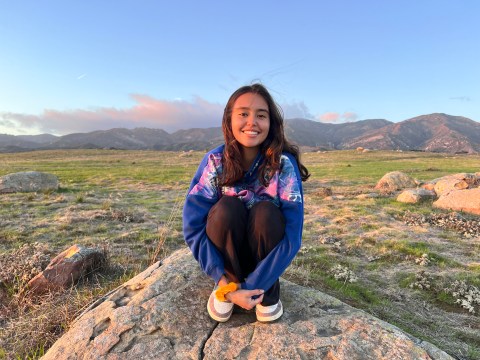
Natalia Valdés Heredia (Oakes ’23, ecology and evolutionary biology) said her research experience was “life changing.”
Natalia Valdés Heredia (Oakes ’23), an ecology and evolutionary biology graduate, called the experience life changing.
“Simply being able to walk on the beach with these massive, magnificent animals was unforgettable,” she said. Her time in the field ignited an interest in the UC Natural Reserve System, and now she works at Hastings Natural History Reservation, which is part of the system, as a fellow at GrizzlyCorps, an AmeriCorps fellowship.
While Valdés Heredia was unsure at first about working among these potentially dangerous animals, her confidence grew until at the end, she felt she could handle any field-tech job.
“This feeling of confidence is gold, both for me and my career,” she said.
Ollie Jackson, mentioned earlier, said their research experiences working under Amy Furniss (M.S. ’09, physics; Ph.D. ’13), an associate teaching professor in physics, and other professors, have set them up for success in their goal of pursuing a Ph.D. in astrophysics. Jackson has worked one year with Furniss studying the cosmic voids between galactic filaments, and how the propagation of gamma rays through cosmic voids could be used to understand the intergalactic magnetic field. Jackson recently traveled to Arizona to observe dwarf galaxies and more with the VERITAS (Very Energetic Radiation Imaging Telescope Array System) at the Fred Lawrence Whipple Observatory outside Tucson.
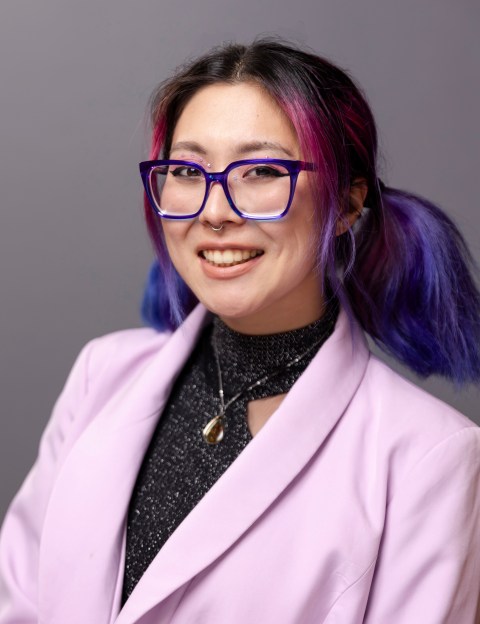
Caitlyn Nojiri (Porter ’24, astrophysics and mathematical theory and computation)
Caitlyn Nojiri (Porter ’24, astrophysics and mathematical theory and computation) said she had an “incredible” experience co-authoring a study showing how a 2.5-million-year old supernova might have affected our planet. Nojiri is now a UCSC astrobiology research associate.
“Going into this project, I did not know what to expect, and I am so grateful that I had the opportunity to work under the mentorship of two amazing scientists, Dr. Noémie Globus [UCSC postdoctoral Simons Fellow] and Dr. Enrico Ramirez-Ruiz [professor of astronomy and astrophysics], who have continued to support me and push me to do my best work.”
While research progress with undergrads can sometimes be slow and frustrating, students learn a lot, said Stefano Profumo, a physics professor who supervised two undergrads working on a paper about the origin of early supermassive black holes.
“They get the message they can make a difference, and they are truly excited about staying in academia,” Profumo said.
Social Sciences: Determining sustainable food for farmed fish; socioeconomic context of COVID in Latinx community
Duncan Gwynne (Cowell ’23), said it was only after he graduated from UC Santa Cruz that he realized what a great undergraduate opportunity he received when he contributed to research into sustainable aquaculture feed development for rainbow trout. He worked under Assistant Professor of Environmental Studies Pallab Sarker and is listed as coauthor on the paper, which was published Feb. 25 in Foods.
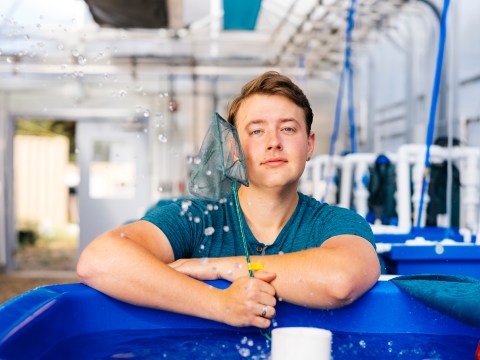
Duncan Gwynne (Cowell ’23, agroecology and marine biology) was a listed coauthor on a published paper.
Gwynne and the team investigated using alternative sustainable ingredients to avoid overusing small ocean fish like sardines and anchovies. The researchers discovered that a byproduct from microalgae, specifically a strain called Nannochloropsis sp. QH25, can fully replace fishmeal in trout feed without sacrificing fish performance or raising costs.
Gwynne, who graduated with a double major in agroecology and marine biology, has since become a full-time staff member for the university’s Ecological Aquaculture Lab. Looking back, he is amazed that his senior thesis became a published research paper.
“I’m essentially doing what I was doing prior to graduation, but I’m in charge of our aquaculture research,” he said. “I coordinate the trout research and do the analysis. Being able to start an internship with the lab and eventually do my thesis led to a very real job, which is incredible.”
Gwynne’s road to research came through applying for an internship under the U.S. Department of Agriculture–funded program SUPERDAR (Supporting Undergraduates by Promoting Education, Research, Diversity, and Agricultural Resilience). He received a $16,000 stipend that covered his personal living expenses. He had no previous experience in a lab and wasn’t expecting much, but he was pleasantly surprised to see how many opportunities were available to him.
“My interests aligned with the values of the lab,” Gwynne said.
He encourages other undergrads to have the courage to reach out and try these experiences.
“Take every opportunity you can,” he said. “Even if you don’t get published or get an internship, you can try again.”
The Social Sciences Division provides such opportunities through its Building Belonging program, designed to “foster student success, increase engagement, and build a greater sense of belonging for underrepresented undergraduate students.”
Student fellows receive $1,500 per quarter and are expected to contribute 80–90 hours per quarter to a project.
Eileen Amador (Kresge ’23, legal studies) helped with a research project on what GoFundMe posts reveal about the socioeconomic context of COVID-19 death and bereavement among Latinx and Spanish-speaking communities in the United States.
She said she learned about the value of having strong research and writing skills, how data can establish opinions and solutions, and the unique challenges of her community.
“Ultimately, this research allowed me to become more passionate about understanding the inequities of Latinx communities and finding ways to address them in meaningful ways,” Amador said.
All of the above helps her now in her work as a legislative aide for state senator Monique Limón, who represents Santa Barbara and Ventura counties.
“I am deeply grateful to have had experience as a research assistant and to apply those skills to my current role,” Amador said.
Other Building Belonging projects included research on immigrants targeted by scams and the trade-offs local and national governments make involving economic and health benefits in relations with Big Pharma.
Engineering: Exploring ways to use tech for good; expanding undergraduate research opportunities to freshman year
As director of the Tech4Good lab, David Lee, assistant professor of computational media, has helped facilitate research for some 250 undergrads a year on projects that help individuals and communities reach their full potential.
Research projects include a study considering ways to design online communities centered on gratitude as a way to enhance well-being, and an investigation into the challenges of forming and sustaining small groups built on shared interests.
Now, he’s hoping to help other faculty members expand research opportunities through his new job as the Baskin School of Engineering’s first director of research pathways. His goal is to share best practices and help faculty members offer undergraduate research in a sustainable way.
He is inspired by a program at Georgia Tech’s Vertically Integrated Projects (VIP) Program, which engages undergrads in long-term, large-scale multidisciplinary projects starting as soon as their freshman year.
“As the students increase in their involvement, they mentor new cohorts,” he said, adding that they can earn credits toward their degrees.
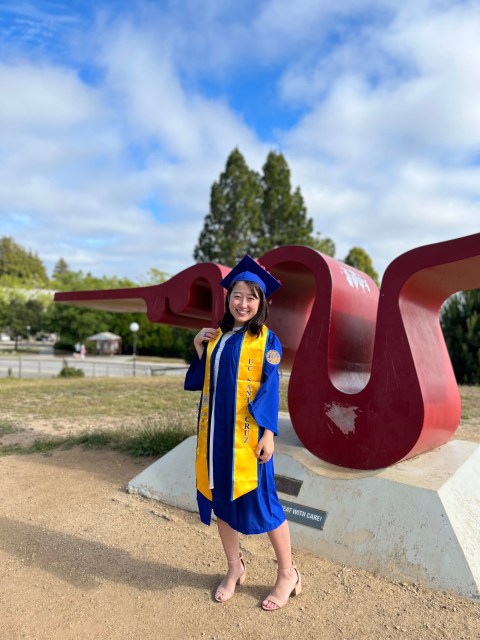
Sayaka Kozuki (College Nine ’23, molecular, cell and developmental biology) coauthored a paper on stem cell–based embryo models using epigenome editing.
Baskin is now offering exploratory reading groups and skill-building groups aligned to potential research that undergrads can enroll in first to see if any of it fires their imagination. Those who go through these groups are more ready to take on a research commitment.
“It helps when there are students coming in with more context to move forward and to be able to contribute at a more steady pace when they do join the research team,” he said.
Best of all, this kind of sustained exposure to research opportunities can make the students’ coursework come to life.
“Classes become more than just assignments,” Lee said. “It becomes, ‘I have this thing I’m passionate about exploring and then I’m using these tools,’ as opposed to, ‘I’m learning these tools to pass the final exam and I don’t see how it connects.’”
Sayaka Kozuki (College Nine ’23) said she was so grateful to work on research as an undergraduate in molecular, cell and developmental biology, during the pandemic when many lab courses were forced online.
“Joining a research lab became my first real opportunity to perform experiments, and as an international student studying in a different country during such uncertain times, the lab provided both a sense of belonging and a clear purpose,” said Kozuki, who is now a Ph.D. student in bioengineering at Caltech. “I spent most of my time there, pushing myself to learn new techniques and develop confidence in my skills. Over time, I began to truly see myself as a researcher.”
That project led to a coauthored paper on stem cell–based embryo models using epigenome editing.
“Looking back, I know this was a transformative experience that shaped not only my undergraduate years but also the path I’m on now,” she said.
Kozuki said the experience taught her to navigate uncertainty.
“I learned that in science and life, the path isn’t always clear …,” she said. “The real challenge is figuring out how to break them down into experiments you can actually perform. That mindset still shapes how I approach problems today.”
Humanities: Zooming in on regional differences of African American language in California; investigating California Spanish; studying artificial intelligence
Elliot-Elyjah Mcwhinnie, a fourth-year student (Kresge ’25), is working with Jaye Padgett, a linguistics professor, to investigate whether African American women’s language in California differs by region and the ways in which it has been influenced by the California vowel shift, a sound largely associated with younger white speakers. He won the Bertha N. Melkonian prize for submitting the top research proposal.
He is conducting interviews with 15 students on campus, focusing on two main groups—Black students from California and Black students from out of state.
Mcwhinnie is especially honored to work with Padgett.

Elliot-Elyjah Mcwhinnie, a fourth-year student (Kresge ’25, linguistics), is working with linguistics professor Jaye Padgett to study African American women’s language in California.
“He has done tons of research revolving around phonetics and phonology,” Mcwhinnie said. “And I admire all the work he has done and continues to do …. He’s never done a research project quite like mine, so it’s an even bigger deal because he believed in me and took on this challenge. We have learned so much together and continue to teach each other about the research that we are doing and why it’s so important for the Linguistics Department.”
A first-generation college student, Mcwhinnie never thought he would get an opportunity like this.
“I mean, I never thought I would get out of my hometown and make something of myself,” said Mcwhinnie, who is from the Baldwin Hills neighborhood of Los Angeles. “So to be here and contribute to something that’s bigger than myself is amazing. I feel like I have already gotten so much out of this experience, and I am just getting started.”
His research work is giving him confidence to pursue a Ph.D. in linguistics and possibly become a teacher.
“I have a calling to pour back into the youth of today,” he said. “When I was younger, school was my escape. Being able to learn and immerse myself in all kinds of subjects drowned out the chaos going on at home.”
Humanities EXPLORE pays students $20 an hour to work on faculty-led research. This year, 74 undergrads are involved in 28 projects within the Humanities Division. For the first time this year, they met as a cohort to reflect on their experiences.
“We aim to nurture transferable skills for the researchers,” said Kylie Rachwalski, the Humanities Division’s assistant director of experiential learning.
One project examines Spanish-English speech samples from across California, with six undergrads researching California Spanish.
“Students gain transferable skills like teamwork, critical thinking, data analysis, and problem solving,” said Mark Amengual, professor and chair of the Department of Languages and Applied Linguistics. He considers working with undergrad researchers one of the most rewarding aspects of his job because he is able to expose students to bilingualism research and to incorporate their own interests. He feels fortunate to have been able to work with motivated students who are eager to learn and get involved in the Bilingualism Research Lab. “For many of the students I work with, the research we carry out in the lab has a deep personal significance for them as it speaks to their own language background histories,” he said
Another project focuses on examining the relationship between human imagination and artificial intelligence (AI) technosystems. Zac Zimmer, associate professor of literature, is leading three undergrads in exploring AI representations in contemporary media such as films, literature, and art. Students are developing metacognitive skills to understand the impact of massive technological shifts. The research provides an opportunity to reflect on what it means to write and read when machines can perform these tasks.
Arts: Researching the historical moment that inspired a play
Sara Sotelo (Merrill ’23, education, democracy, and justice) won a Koret Award to complete a dramaturgical casebook (historical analysis) on the then-new play Unibeauty and Her Wicked Daughters. The play—by Frances Ya-Chu Cowhig—was a “darkly comedic political fairytale about the corporate hijacking of the 14th Amendment to shield themselves from their liabilities at the expense of the health of their consumers.”
Sotelo said she loved seeing how her research changed and helped the actors’ performances.
“It is such a small and subtle difference but you start to recognize it’s because they now understand a historical, social, or cultural context behind a line or a scene,” she said.
Michael Chemers, a professor of dramatic literature who is an expert in dramaturgy, said this was a particularly exciting project because it was a new play, so all the historical research Sotelo did was new. Only certain undergrads have the capacity to do this kind of work, he said.
“You have to have a very serious mind,” he said. “You have to not be afraid of libraries, and you have to think of theater in a very systematic way.”
The casebook helped Sotelo gain admission to graduate school at UC Santa Barbara, where she is now pursuing a master’s degree in theater, dance, and performance studies.
“I was able to showcase that I can speak historically, culturally, socially, or politically about theater,” she said. “I also learned how to be a professional dramaturg in an educational setting.”
For current students looking to explore research opportunities or find helpful resources and funding, the undergraduate research website is a great place to start.