

Above: Rob Irion (SciCom ’88), longtime UC Santa Cruz lecturer and former Science Communication Program director (photo by Carolyn Lagatutta)
As a very special lecture took place in a tiny classroom in the sleek new Kresge College Academic Center, even the redwood trees outside the big picture windows seemed to lean in close and listen.
Rob Irion (SciCom ’88), longtime UC Santa Cruz senior lecturer and former Science Communication Program director, wrapped up 25 years of teaching this past fall with some parting words of wisdom for his graduate students in his Science News Reporting course. His very last class, held December 5, recapped the fundamentals he most wanted to impart, including the value of professional standards, what editors need, and understanding the publication they’re writing for.
“How deeply do they dive into, for instance, the scientific methodology of the study?” Irion asked, as his 10 students took notes by hand and on laptops.
“His last lecture was truly moving,” said Anna FitzGerald Guth (SciCom ’25). “Some of my classmates and I were holding back tears. Rob does everything in his power to set his students up for success. He’s the most dedicated, inspirational teacher I’ve ever had.”
Irion’s students and colleagues—from budding science communicators to Pulitzer Prize–winning journalists—are quick to report that his dedication to students, alumni, colleagues, and the profession of science journalism is unrivaled. His unique teaching and mentorship style continues to ripple out, impacting the lives and careers of hundreds of former students, many of whom are now prominent science journalists.
UCSC’s Science Communication master’s program—SciCom for short—provides one academic year of rigorous, practical training in all aspects of science journalism and communications, including reporting, interviewing, feature and news writing, and editing, while cultivating professional standards, ethics, networking, and a focus on the whole person who will go out into the world as a journalist or science communicator.
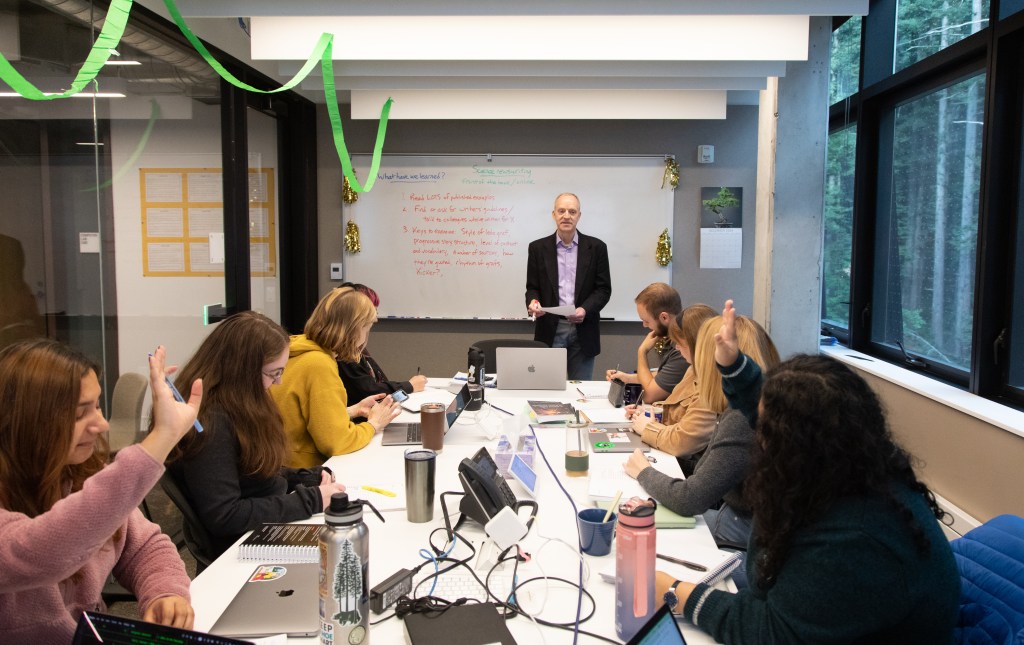
Irion teaching his last class at UC Santa Cruz (photo by Carolyn Lagatutta)
Students intern at prominent news organizations, reporting on science trends, discoveries, personalities, and policies. SciCom alumni have gone on to work at outlets and institutions worldwide, including the New York Times, NPR, National Geographic, NASA, universities, and museums; produce digital newsletters, streaming documentaries, and podcasts; and win dozens of awards.
“Rob has been the heart of the program for more than half its existence,” said Erika Check Hayden, program director since 2017. “As director, Rob transformed the program, creating the core model that’s made it the leading science journalism training program in the world. He professionalized and nationalized our curriculum and reach, and you can see the results of his vision today in our students’ incredible trajectories—our alums lead the science journalism field.”
For 25 years, Irion has devoted himself to UCSC’s SciCom Program and students. Now he’s stepping away to write the next chapter of his own life, and is excited about traveling to new places; spending time with his husband, Barry Grigsby; playing beach and grass volleyball with his lifelong friends; and reconnecting with the natural world in the spirit of curiosity and wonder that sparked his love of science in the first place.
Falling in love with science
Irion fell in love with astronomy as a young child gazing up at the stars.
“I grew up in rural northwestern Vermont, where the night skies were wonderfully dark,” he said. “I could see the Aurora Borealis in the winter.”
His great aunt Ruth, noticing her 5-year-old nephew’s blossoming interest in science, started mailing him monthly packets of New York Times science sections. She enrolled him in a Science Experiments of the Month Club, gave him his first handheld calculator, and sent him a star chart and books on astronomy. She took him to New York City’s Hayden Planetarium and Philadelphia’s Franklin Institute, where Irion recalls her laughter as the static electricity–generating Van de Graaff machine made his fine blond hair stand straight out from his head.
“Aunt Ruth opened up the world and showed me the vibrancy of city life and major universities,” Irion said. “It was always with her at my side—during all our trips together and as an inspiration. She’s the reason I’m where I am today.”
As a teen, Irion loved science and math classes at his rural high school, worked at his father’s grain and hardware store, and got hooked on Carl Sagan’s Cosmos TV series. Wanting to be an astronomer, he studied undergraduate physics and astronomy at MIT. But while he loved the coursework and stellar students there, he found the practice of science less appealing. Leaning into his creative writing minor, Irion joined one of the student newspapers and became managing editor. When a science journalism professor mentioned UCSC’s SciCom Program, founded in 1981 by former MIT lecturer John Wilkes (Cowell ’67, literature; M.A. ’69; Ph.D. ’73), Irion contacted Wilkes to learn more.
For two years after graduating with a degree in Earth and planetary sciences, Irion worked as a local newspaper reporter in Massachusetts before heading to California in 1987 for what he thought would be just one year at UCSC before starting a career elsewhere.
Instead, Irion met a sociology major named Barry Grigsby (Merrill ’89, sociology) at a campus dance three weeks after moving to Santa Cruz, and they quickly fell in love. Toward the end of the SciCom Program, Irion moved to Chicago to intern with the Chicago Tribune, which offered him a job on the science desk.
“I was really gratified by that offer, very torn by that,” Irion said. “But I’d met my future husband and came back to Santa Cruz for a life with him. That decision was such a profound fork in the road—one I’ve always openly shared with my students. To be the best journalists, writers, and communicators, we need to have full lives and be part of society. A huge part of that is being happy and content with where you are.”
A mentor in journalism and in life
Alum Nicholas St. Fleur (SciCom ’14)—an award-winning science and health journalist (New York Times, Atlantic, STAT) and Color Code podcast host with a penchant for dinosaurs, mummies, and space—took Irion’s advice to heart when he faced a similar decision during the SciCom Program. He’d just begun dating a young woman and asked Irion if he thought he could balance a new relationship with the demands of the program.
“Rob said, ‘Oh gosh, Nick, of course! You’ve got to live your life. Yes, do—date her!’ A few months ago, we got married in a planetarium. I definitely thank Rob for that advice. He’s there for you as a mentor in science journalism and in life,” St. Fleur said.
Irion realized the value of mentoring at his first job after graduating from UCSC: covering science research for the UCSC Public Information Office (1989–97), which included supervising and mentoring SciCom Program interns.
“I really learned what it was to be an individual mentor, not only editing their work, but also discussing what they wanted to achieve, their professional goals, and how they wanted their job and life to develop side-by-side,” he said.
Irion’s ability to translate scientific research into general-audience news stories made him an important member of a first wave of national science communicators, said Jim Burns, UCSC’s former director of public affairs and Irion’s supervisor at the time (Burns retired in 2014).
“I saw firsthand how much reporters valued Rob’s work, trusted his story research and writing, and were grateful for the helpful background information he provided about often very complex subjects,” Burns said.
Building community
When Irion started formally teaching SciCom courses in 2000 as a freelance magazine journalist, he actively discussed professional standards and ethics, and the importance of relating to each other as high-caliber writers and journalists.
“I saw that in action throughout my own career, how important it was to be part of this community,” Irion said. “That’s one big reason why I volunteered for the National Association of Science Writers [NASW] and played a critical role in their education programs.”
Besides co-chairing the NASW education committee and helping to organize the annual internship fair, Irion also handled undergraduate travel fellowships. He won the 2012 Diane McGurgan Service Award for his exceptional contributions.

Willie E. May, president of the American Association for the Advancement of Science (left), inducts Irion as a fellow of the association in Washington, D.C., on Sept. 21, 2024. (Photo by Linnea Farnsworth)
In a gratifying result for Irion, alum and freelance science journalist Sandeep Ravindran (SciCom ’11) is now NASW president.
Irion cares deeply about each student, keeps those connections alive, and is great at connecting alumni with the right people, said Ravindran.
“He definitely modeled a highly caring and joyful mentorship style that I try to follow today,” Ravindran said.
An infamous colored pen
Irion’s students know he’s always there for them. They also know he’s a meticulous editor who’s handy with his fine colored markers (any color but red!).
Julia Calderone (College Nine ’08, neuroscience; SciCom ’14), a Pulitzer Prize–winning journalist who covered the pandemic outbreak for the New York Times, will never forget her first editing session with Irion—an experience many SciCom alumni share.
“Writing this big feature story was our capstone for the year,” Calderone said. “Mine was on intestinal worms. I wrote what I thought was a great story and went into Rob’s office thinking, ‘He’s going to have no notes for me, this is great!’ And he ripped me to shreds, he ripped the whole story apart. It was a very serious, stern meeting, like, ‘You need to work on this, this is not great.’”
Calderone remembers feeling defeated and humbled.
“But,” she continued, “it taught me what it’s like to be edited by a tough editor, and it set me up to work with tough editors in the future. It gave me the tools to be resilient and learn how to take critical feedback, which is 100% of the job.”
That kind of ruthless editing is invaluable, agreed former Smithsonian magazine and Scientific American editor Laura Helmuth (SciCom ’98), a former NASW president—who herself edited many science features by Irion.
“Writing is hard, and a good editor can make the writing less scary and help the writer be even more ambitious, even more precise and emphatic about the points they want to make,” she said.
Learning from the best
When Irion became SciCom Program director in fall 2006, after Wilkes retired, he set about further elevating the program by enlisting some of the most inspiring communicators working in the field.
“We hire people who’ve been doing this professionally for a long time at a high level,” Irion said, mentioning Martha Mendoza (Kresge ’88, journalism and education), a two-time Pulitzer Prize–winner and Associated Press reporter, and Peter Aldhous, whose many editing and reporting credits include Nature, Science, New Scientist, and BuzzFeed News.
These experts share with students their own investigative projects from the genesis—where ideas come from, how they develop their reporting, how they interview and protect sources, how they deal with controversial subject matter and adversarial interviews, and how they write about public policy.
The program was shaped in Irion’s image, said Aldhous.
“It stands or falls on the commitment, the teaching skills, the mentorship provided by the director and the small number of adjuncts and staff,” he said.
Changing times
Irion loves teaching and mentoring so much that, even as he steps back from UCSC, he says he will remain available as a mentor and adviser to his alumni.
“It’s time for a more active journalist to take on my role,” said Irion. “I’ve been focusing on my teaching and haven’t been an active journalist for a while now. I’m not involved with social media at all, which is clearly critical, so I think it’s time to step aside.”
The current pushback on expertise and science, and what that means for society going forward, concerns Irion. But the hundreds of students that he and the SciCom faculty have mentored and trained also give him great hope.
“It’s the critical question confronting our profession,” he said. “It revolves around this question about social media, where people get their news. We need to understand foundationally how to break through barriers, and we’re going to need younger, very plugged-in journalists who have been part of those online communities to be able to relate to the audiences who have become distrustful.”
He mentioned current SciCom director Check Hayden as among that cohort, adding that her continued directorship gives him hope that younger journalists will find effective new ways to communicate crucial, accurate science news and reach people where they are.
Helmuth, the former Smithsonian magazine and Scientific American editor, agreed.
“The biggest challenges the world faces right now are climate change, infectious disease, and misinformation and propaganda,” she said. “Science communication is central to helping turn this around. I don’t think we’ll defeat any of those three, but empowering people to resist them is possible.”
Reflecting on his quarter-century of working with students, Irion said: “Teaching has paid me back in so many ways. It’s the best thing I’ve done. I’ve been a top-caliber journalist and won awards for my own work, but by far what’s impacted my legacy in this world are the 250 people I’ve helped to train.”
To be able to watch their work for years, to get to see them in action, and to see how much joy they find in their profession—that’s the reward, he said.
“I hope to have another 25 years of watching the careers of my students unfold,” Irion added, “and I can’t wait.”