


In honor of UC Santa Cruz’s upcoming 60th anniversary year, UC Santa Cruz Magazine editors and designers dug through the archives to present some notable campus milestones and achievements during each of the university’s six decades.
During the 1985–1994 decade, we discovered a radical proposal in genomics; leadership shifts; significant recognitions for alumni; legacies established with transformative gifts; expansion of academic offerings; the birth of a beloved mascot; and more.
Put on your best Slug pride gear, close your eyes and imagine the wind in your face as you sail down the Great Meadow bike path from the Music Center, and take a tour with us through the years.
Research breakthroughs and prominence
A radical proposal
In 1985, a group of eminent biologists gathered at UCSC to discuss a radical proposal put forth by Chancellor Robert Sinsheimer, a molecular biologist. His idea was to launch a massive project to determine the complete DNA sequence of the human genome. Five years later, the Human Genome Project was officially launched, and 10 years after that project leaders announced with great fanfare the completion of a working draft of the human genome sequence.
Astronomical leap
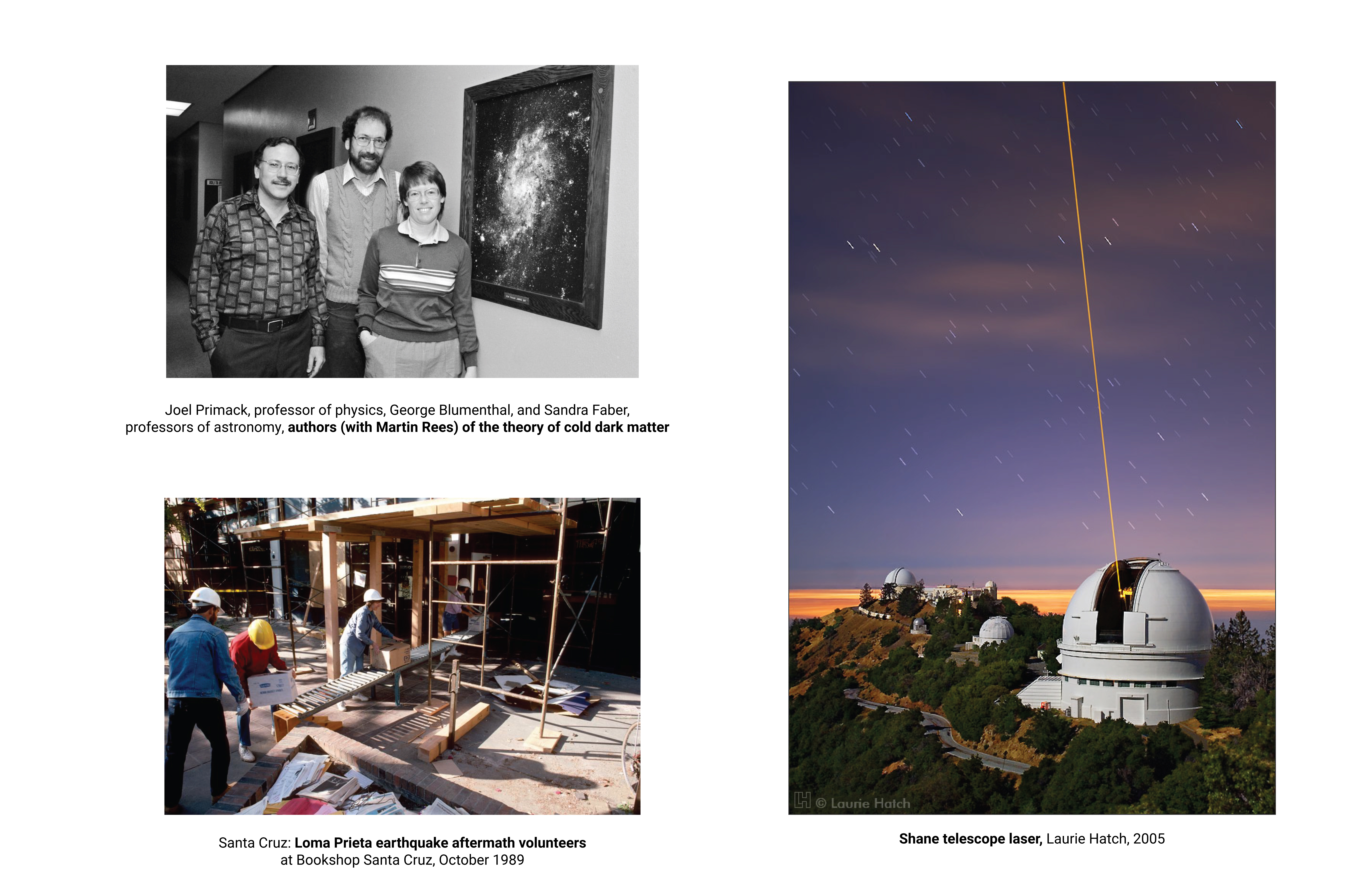
A new instrument dedicated in 1986 made Lick Observatory preeminent in the science of high-resolution spectroscopy—the detailed analysis of light from astronomical objects. The new instrument—built entirely in the Lick Observatory shops on campus—coupled with the three-meter Shane Telescope and allowed astronomers to examine the light from stars and galaxies faster and in greater detail than any other existing telescope-spectrograph combination.
Peering into dark matter
UCSC researchers drew attention in 1994 by making major advances in the quest to understand dark matter.
Growing campus …
… and growing pains

Students studying tidal pools, 1989
More than 15,000 prospective students applied for 2,500 openings at UC Santa Cruz in fall 1989. Almost overnight, it seemed, the campus had reemerged as one of the most popular in the UC system. Instead of closing down, as was being speculated a decade before, UCSC began a period of growth reminiscent of its infancy. Housing projects at Oakes and Kresge colleges and a 50-meter swimming pool and physical education building at the East Field recreation complex had all recently been finished. Before the academic year began, a state-of-the-art building for the natural sciences, the first phase of residence halls and other facilities planned for College Eight, and a student center were also scheduled for completion.
Not surprisingly, UCSC’s plans for expansion sparked considerable debate between local officials and campus administrators.
A decade of building out
The first phase of the Elena Baskin Visual Arts Studios near the Performing Arts Center was completed in 1985, providing teaching studios for drawing, painting, printmaking, and sculpture. Phase two would expand facilities for similar activities, centralize photography and sculpture studios, and provide long-desired faculty studios and administrative space.
Construction began in 1985 on two new concrete tanks at Long Marine Lab for a community of marine mammals.
Construction began in 1987 on a permanent home for College Eight, which was established in 1979 but had not previously received funding for traditional facilities. It had functioned on several floors of Clark Kerr Hall, and some College Eight students were housed in other colleges.
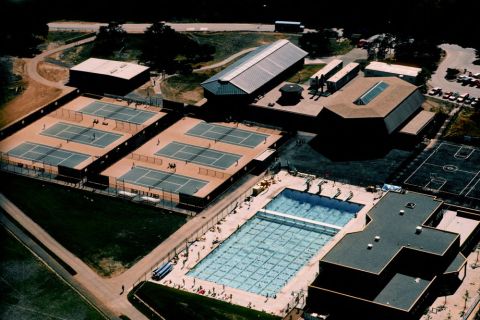
East Field House pool aerial view, June 1988
Construction began in 1987 on an upgrade to UCSC’s recreation and athletic facilities, including an Olympic-sized swimming pool and a second multipurpose field. Already completed at the complex were an all-weather rubberized jogging track.
After a three-month, Loma Prieta earthquake–induced postponement, the $21.3 million Robert L. Sinsheimer Laboratories were formally dedicated in 1990.
Scientific library research at UCSC entered a new era when the $13.7 million Science Library was dedicated in 1991.
Construction began in 1992 on College Nine, the first of two colleges, along with College Ten, planned for a 32-acre site north of the Cowell Student Health Center.
Academic advances
The Institute of Tectonics was established in 1986, bringing together researchers from different fields to study what was then a young science.
Selected meadows, groves, and gulches on the UC Santa Cruz campus—and the educational resources they harbor—found protection from future building pressures in a Natural Areas Reserve approved by Chancellor Robert Sinsheimer in 1986. The proposal protected more than 400 acres of the sprawling 2,000-acre campus.
The Center for the Molecular Biology of RNA began in 1992 with a five-year, $2.5 million grant from the Lucille P. Markey Charitable Trust. The group’s mission was to untangle one of biochemistry’s most daunting challenges: understanding the many structures and functions of the extraordinary molecule called RNA.
Transformative gifts
A $1 million donation from philanthropist Jack Baskin established the Baskin Center for Computer Engineering and Information Sciences, which opened in 1986 and included dazzling computer animation and computer graphics, intricate image processing, an electronic library, and an 18,000-square-foot space housing the latest in computer technology.
Leadership shifts
Chancellor Robert B. Stevens takes the helm
Robert B. Stevens, president of Havertord College in Pennsylvania since 1978, was selected chancellor of UCSC in 1987, succeeding Chancellor Robert L. Sinsheimer, who retired after serving 10 years in the campus’s top post.
Interim, then permanent, Chancellor Karl S. Pister
Karl S. Pister, a distinguished faculty member and administrator at the UC Berkeley campus, assumed the position of interim chancellor at UCSC in August 1991, then was appointed permanent chancellor later that year. He succeeded Robert Stevens, who resigned to practice law for a London firm. Pister had served for 10 years as dean of Berkeley’s College of Engineering.
Historic events
The 7.1-magnitude Loma Prieta Earthquake struck at 5:04 p.m. on October 17, 1989. In downtown Santa Cruz, buildings crumbled and three people died; one person was killed by a toppled building in downtown Watsonville. In all, 63 people in Northern California, including six in Santa Cruz County, perished from the earthquake that day, whose epicenter was in the Forest of Nisene Marks State Park. The campus sustained $11 million in damage and property loss from the fourth-largest quake ever recorded in California at that time. Cleanup costs on campus were estimated at $1 million.
A mascot is born
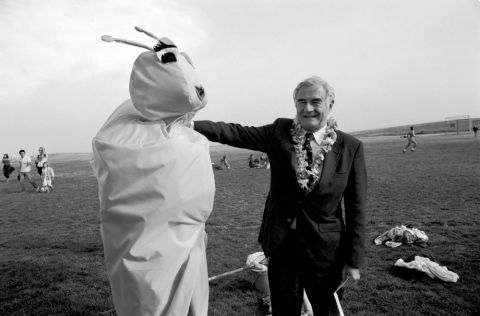
Students in a banana slug costume with Chancellor Robert Sinsheimer at the Banana Slug Spring Fair on the East Field
An overwhelming pro-Slug vote by students in 1986 convinced the skeptical Chancellor Robert Sinsheimer to make the humble but adored Banana Slug UCSC’s official mascot.
Significant recognition
Alumnus Hector Tobar won the Pulitzer Prize in 1993 for his coverage of the Los Angeles riots for the Los Angeles Times.