


In honor of UC Santa Cruz’s upcoming 60th anniversary year, UC Santa Cruz Magazine editors and designers dug through the archives to present some notable campus milestones and achievements during each of the university’s six decades.
During the 1975–1984 decade, we discovered a campus undergoing some turmoil as it grew and changed, leading to leadership shifts and reorganization; legacies established with transformative gifts; expansion of academic offerings; the birth of iconic programs; and more.
Put on your best Slug pride gear, slather on some Coppertone and bask in memories of Suntan Psych, and take a tour with us through the years.
Changing times
Enrollment dip
For the first time in the campus’s history, undergraduate enrollment declined in 1977. UC Berkeley’s “redirect program” helped bring enrollment back to normal yearly growth by 1980.
Academic reorg
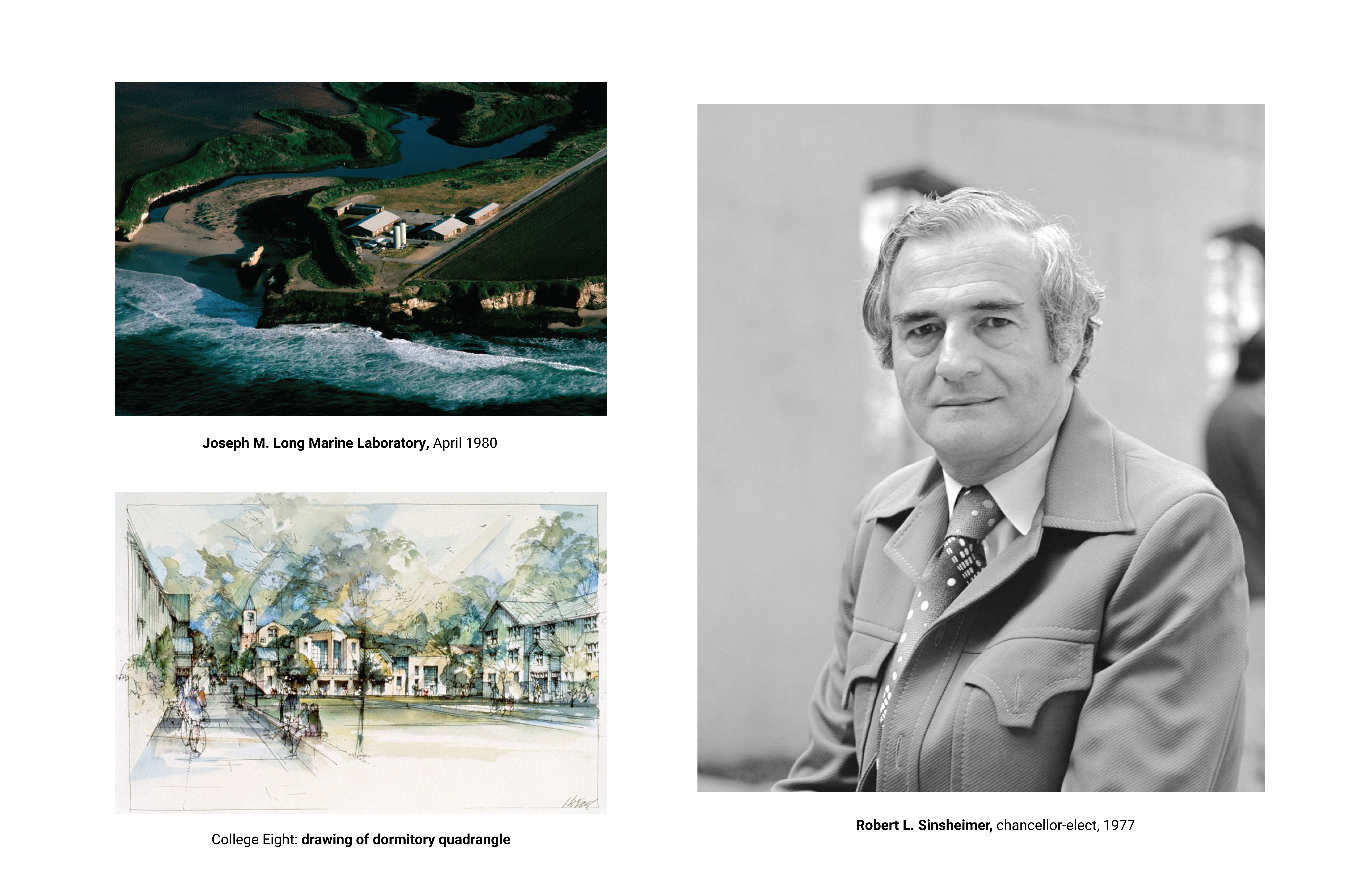
In 1978, Chancellor Robert Sinsheimer (see Leadership Shifts, below) presented a reorganization plan that gave management of academic programs largely to divisions and boards of studies (which functioned like departments), and clustered faculty in disciplinary groups within colleges.
Shades of grade
The Academic Senate approved offering a letter-grade option as a supplement to the narrative (written) evaluation grading system in 1979.
Competitive spirit
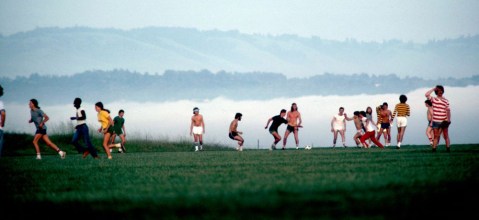
Soccer on the East Field, April 1980
UCSC teams entered the NCAA in 1980, competing in Division III.
Leadership shifts
A chancellor resigns
UCSC’s second chancellor, Mark N. Christensen arrived during a tumultuous point in the campus’s history, as UCSC experienced the political and economic pressures of trying to establish a decentralized, innovative campus within the traditional University of California. Christensen resigned in 1976 after stormy confrontations with faculty over administration and organization of the campus. University Provost Angus E. Taylor was named acting chancellor.
A consequential leader is appointed
Robert L. Sinsheimer, a genetic biologist from the California Institute of Technology, became UCSC’s fourth chancellor in 1977. He would leave a lasting legacy by leading a young UC Santa Cruz through major changes, from the audacious to the controversial.
Growing campus
A lab is born
The first phase of Joseph M. Long Marine Laboratory was completed in 1978 on the oceanside site given by Santa Cruz residents Marion and Donald Younger.
Engineering an arts space
A $1 million gift from Jack and Elena Baskin built a new home for UCSC’s artists, freeing up space in the Applied Sciences Building for computer engineering. The new labs would be called the Jack Baskin Computer Engineeing Laboratories. The Elena Baskin Visual Arts Studios were dedicated on the campus’s west side in 1985.
The state of Eight
College Eight was established in 1979, but it had no permanent home until the 1980s because it was never provided with funding for traditional facilities. It functioned on several floors of Clark Kerr Hall, and some College Eight students were housed in other colleges.
Historic events
A crowd of 3,500 filled the East Field House lawn in 1979 to hear the exiled Dalai Lama of Tibet.
Expanding academics and opportunities
Small things considered
The Santa Cruz Institute for Particle Physics was founded in 1980.
Great expectations

Linda Hooper (left) and unidentified attendees in costume at a Dickens Project Victorian event at University House
The Dickens Project was established in 1981 as an intercampus research group to further academic investigation and teaching of Charles Dickens’s works in the context of Victorian society.
A first act
Shakespeare Santa Cruz presented its first season in 1982, featuring outdoor performances of A Midsummer Night’s Dream in the Festival Glen and King Lear in the Performing Arts Theater.